Hypothesis
This knowledge is used in careers such as:
Teacher (Teaches Students) ~$55,000 - $95,000 - Number of jobs: 4,700,000 (324,500 Openings Per Year) +2% Growth
Civil Engineer (Designs Infrastructure) ~$65,000 - $110,000 - Number of jobs: 370,000 (23,600 Openings Per Year) +5% Growth
Electrical Engineer (Designs Electrical Systems) ~$65,000 - $115,000 - Number of jobs: 295,000 (17,500 Openings Per Year) +7% Growth
Mechanical Engineer (Designs Machines) ~$65,000 - $115,000 - Number of jobs: 290,000 (18,100 Openings Per Year) +9% Growth
Project Manager (Coordinates People to Build Something) ~$65,000 - $115,000 - Number of jobs: 1,000,000 (78,000 Openings Per Year) +6% Growth
Explore These Careers →

Example:
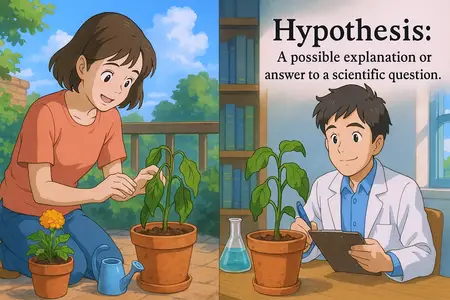
Imagine trying to figure out why your favorite plant is wilting despite regular watering. This situation mirrors how scientists approach forming a hypothesis, which is essentially a possible explanation or answer to a scientific question. Just as you might consider various reasons for the wilting—like too much sun, a pest infestation, or poor soil quality—a scientist proposes a hypothesis to explain an observed phenomenon, testing each possibility to find the right solution.
Practice Version
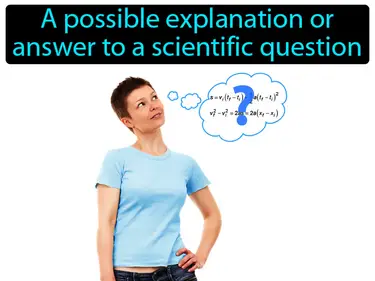
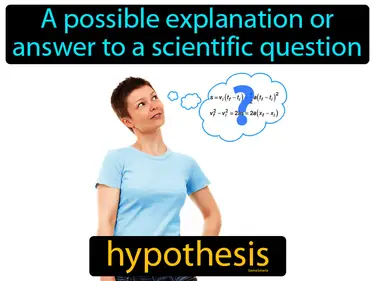
Hypothesis: A possible explanation or answer to a scientific question hypothesis. A hypothesis is an educated guess that scientists test through experiments and observations.