Scientific Theory

Example:
Imagine trying to figure out why your favorite homemade bread sometimes turns out perfectly and other times comes out flat. This situation is similar to a scientific theory because just as you would test different variables like yeast type, rising time, and oven temperature to consistently achieve the perfect loaf, a scientific theory is a well-tested explanation that has been refined and supported by multiple experiments and observations. In this analogy, your repeated bread-baking experiments are like the wide range of observations and tests that back a scientific theory, ensuring that the explanation is reliable and can predict outcomes accurately.
Practice Version

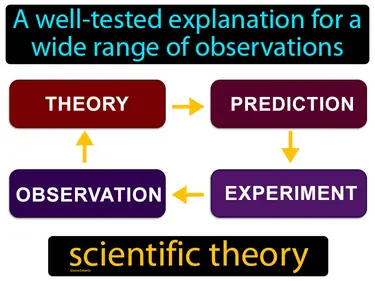
Scientific Theory: A well-tested explanation for a wide range of observations. Scientific theory. A scientific theory is an in-depth explanation of a natural phenomenon supported by a lot of evidence.