Scientific Law

This knowledge is used in careers such as:

Teacher (Teaches Students) ~$55,000 - $95,000 - Number of jobs: 4,700,000 (324,500 Openings Per Year) +2% Growth

Civil Engineer (Designs Infrastructure) ~$65,000 - $110,000 - Number of jobs: 370,000 (23,600 Openings Per Year) +5% Growth

Electrical Engineer (Designs Electrical Systems) ~$65,000 - $115,000 - Number of jobs: 295,000 (17,500 Openings Per Year) +7% Growth

Mechanical Engineer (Designs Machines) ~$65,000 - $115,000 - Number of jobs: 290,000 (18,100 Openings Per Year) +9% Growth

Project Manager (Coordinates People to Build Something) ~$65,000 - $115,000 - Number of jobs: 1,000,000 (78,000 Openings Per Year) +6% Growth

Explore These Careers →

Scientific Law Meaning

Example:

Imagine you're trying to predict when your morning coffee will be ready based on how long it usually takes the coffee machine to brew. Just like the consistent brewing time of your coffee, scientific laws describe consistent patterns observed in nature. The way your coffee machine reliably takes the same amount of time each morning is similar to how scientific laws predict natural phenomena, emphasizing the predictability and regularity both in your kitchen and in the natural world.
Scientific Law Definition

Practice Version

Scientific Law Definition

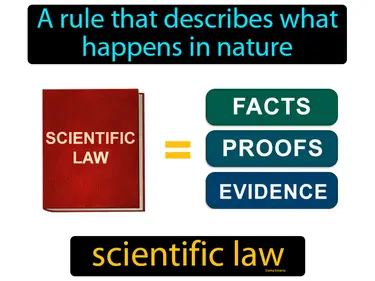
Scientific Law: A rule that describes what happens in nature. Scientific law. A scientific law is a statement based on repeated experiments that describes a consistent natural phenomenon.

YouTube Video: