Seafloor Spreading

Example:
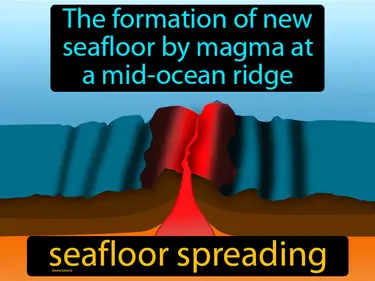
Imagine you're trying to fit a growing collection of books on a shelf that's already full. This is like seafloor spreading, where new seafloor is created by magma at a mid-ocean ridge, pushing the older seafloor aside. Just as you need to make space on the shelf by shifting books to accommodate new ones, the Earth's plates are moved apart by the formation of new seafloor, with the mid-ocean ridge acting as the point where new "books" (magma) are added, and the "shelf" (ocean floor) expands.
Practice Version

Seafloor Spreading: The formation of new seafloor by magma at a mid-ocean ridge. Seafloor spreading. It is a process where new oceanic crust forms as magma rises and solidifies at mid-ocean ridges, gradually pushing older crust apart.