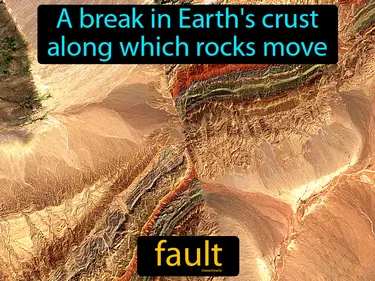
Fault

Example:
Imagine walking on a sidewalk when you suddenly come across a crack where the two sides have shifted slightly apart. Just like this crack disrupts the smooth path you intended to walk on, a fault is a break in Earth's crust where sections of rock have moved relative to each other. In both cases, the crack represents a division where shifts have occurred—on the sidewalk, it's the concrete slabs moving apart, while in Earth's crust, it's the movement of rocks along the fault line.
Practice Version

Fault: A break in Earth's crust along which rocks move. Fault. It is a crack in the Earth's surface where geological forces have caused rocks to shift.