Transform Boundary

Example:
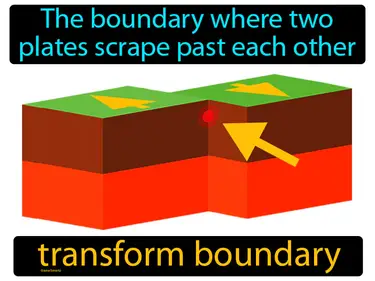
Imagine you're walking in a crowded hallway and accidentally bump shoulders with someone walking in the opposite direction. This situation is similar to a transform boundary, where two tectonic plates slide past each other horizontally. Just as the friction and impact from the shoulder bump can cause a brief jolt or stumble, the friction and stress at a transform boundary can lead to earthquakes as the plates grind against each other. In both scenarios, the interaction is characterized by lateral movement and the release of built-up energy, whether it's people brushing past each other or tectonic plates scraping along their edges.
Practice Version

Transform Boundary: The boundary where two plates scrape past each other. Transform boundary. A transform boundary is a place where two tectonic plates move sideways past each other, often causing earthquakes.