Kinetic Energy
This knowledge is used in careers such as:
Civil Engineer (Designs Infrastructure) ~$65,000 - $110,000 - Number of jobs: 370,000 (23,600 Openings Per Year) +5% Growth
Electrical Engineer (Designs Electrical Systems) ~$65,000 - $115,000 - Number of jobs: 295,000 (17,500 Openings Per Year) +7% Growth
Mechanical Engineer (Designs Machines) ~$65,000 - $115,000 - Number of jobs: 290,000 (18,100 Openings Per Year) +9% Growth
Electrician (Installs & Repairs Electrical Systems in Buildings) ~$50,000 - $90,000 - Number of jobs: 820,000 (81,000 Openings Per Year) +9% Growth
Industrial Technician (Maintains & Repairs Machines) ~$50,000 - $75,000 - Number of jobs: 540,000 (54,000 Openings Per Year) +13% Growth
Explore These Careers →

Example:
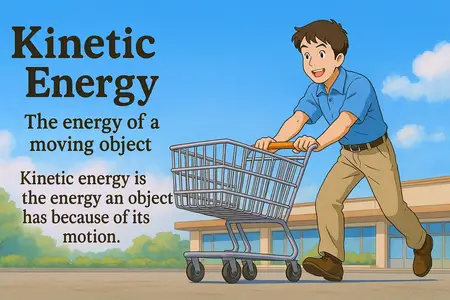
Imagine you're trying to push a heavy shopping cart that’s already in motion. Just like how the moving cart requires less effort to keep rolling than to start from rest, an object in motion possesses kinetic energy, which is the energy due to its movement. In this analogy, the initial push you give to the cart represents the force needed to overcome inertia, while the cart's continued motion is akin to the kinetic energy that keeps an object moving once it has already started.
Practice Version

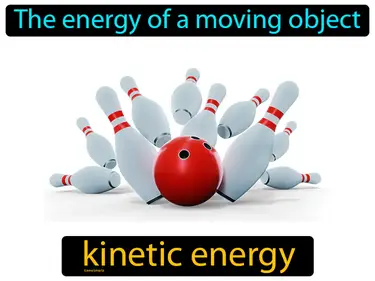
Kinetic Energy: the energy of a moving object