Temperature
This knowledge is used in careers such as:
Civil Engineer (Designs Infrastructure) ~$65,000 - $110,000 - Number of jobs: 370,000 (23,600 Openings Per Year) +5% Growth
Electrical Engineer (Designs Electrical Systems) ~$65,000 - $115,000 - Number of jobs: 295,000 (17,500 Openings Per Year) +7% Growth
Mechanical Engineer (Designs Machines) ~$65,000 - $115,000 - Number of jobs: 290,000 (18,100 Openings Per Year) +9% Growth
Electrician (Installs & Repairs Electrical Systems in Buildings) ~$50,000 - $90,000 - Number of jobs: 820,000 (81,000 Openings Per Year) +9% Growth
Industrial Technician (Maintains & Repairs Machines) ~$50,000 - $75,000 - Number of jobs: 540,000 (54,000 Openings Per Year) +13% Growth
Explore These Careers →

Example:
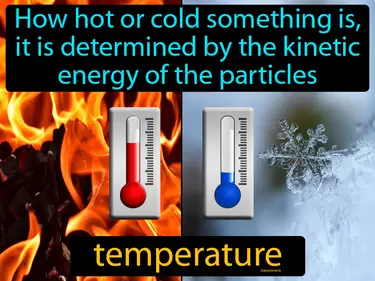
Imagine you're at a party, and you notice how lively or dull it feels depends on how much people are moving around. Similarly, the temperature of an object is determined by how energetically its particles are moving. Just like a high-energy party feels 'warmer' with people dancing and talking, an object is hotter when its particles are moving rapidly, while a 'cooler' party, where people are standing still and quiet, mirrors the slow movement of particles in a colder object.
Practice Version

Temperature: How hot or cold something is, it is determined by the kinetic energy of its particles. Temperature is a measure of how fast the molecules in a substance are moving.