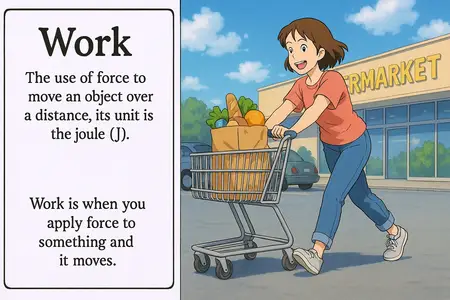
Work
This knowledge is used in careers such as:
Teacher (Teaches Students) ~$55,000 - $95,000 - Number of jobs: 4,700,000 (324,500 Openings Per Year) +2% Growth
Civil Engineer (Designs Infrastructure) ~$65,000 - $110,000 - Number of jobs: 370,000 (23,600 Openings Per Year) +5% Growth
Electrical Engineer (Designs Electrical Systems) ~$65,000 - $115,000 - Number of jobs: 295,000 (17,500 Openings Per Year) +7% Growth
Mechanical Engineer (Designs Machines) ~$65,000 - $115,000 - Number of jobs: 290,000 (18,100 Openings Per Year) +9% Growth
Industrial Technician (Maintains & Repairs Machines) ~$50,000 - $75,000 - Number of jobs: 540,000 (54,000 Openings Per Year) +13% Growth
Explore These Careers →

Example:
Imagine trying to push a heavy shopping cart across a supermarket parking lot. This task is similar to the scientific concept of 'work,' where you apply force to move an object over a distance. Just as you exert effort to push the cart, in physics, 'work' is done when a force moves an object; the energy used is measured in Joules, akin to the energy you use to push the cart forward.
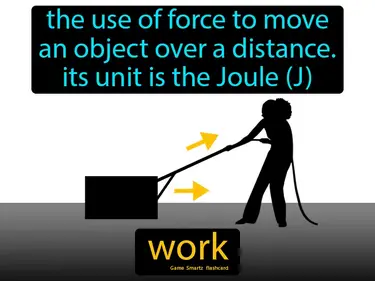
Practice Version
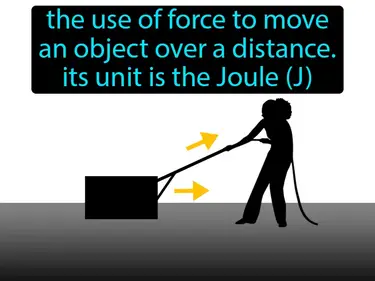
Work: The use of force to move an object over a distance, its unit is the Joule J. Work is when a force makes something move.