Balanced Force
Example:
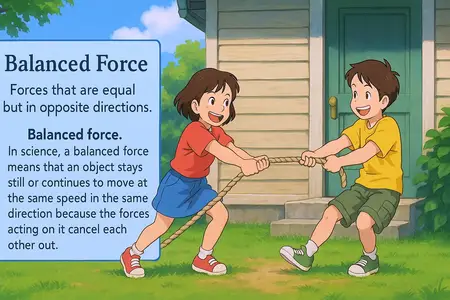
Imagine you're in a tug-of-war with a friend, and despite both of you pulling with all your might, neither of you is moving an inch. This stalemate is similar to balanced forces, where equal forces act in opposite directions, resulting in no movement. In this analogy, your effort and your friend's effort are the opposing forces, and the rope staying still represents the object experiencing balanced forces, showing how neither side overpowers the other, thus maintaining equilibrium.
Practice Version

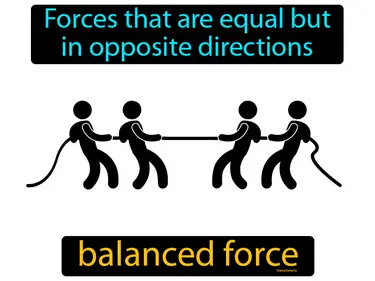
Balanced Force: Forces that are equal but in opposite directions. Balanced force. In science, a balanced force means that an object stays still or continues to move at the same speed in the same direction because the forces acting on it cancel each other out.