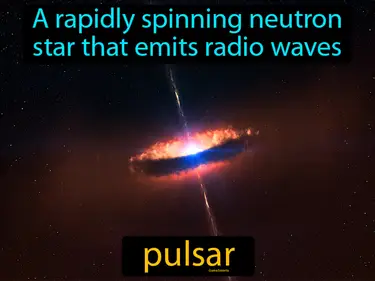
Pulsar

Example:
Imagine you're trying to find a friend in a crowded room by looking for their flashlight beam that briefly sweeps across the room. This is similar to a pulsar, where a rapidly spinning neutron star emits beams of radio waves that sweep across the sky like a lighthouse. Just as you can only spot your friend's flashlight when it points in your direction, we can only detect a pulsar when its beam is pointed toward Earth, creating a regular pulsing signal.
Practice Version

Pulsar: A rapidly spinning neutron star that emits radio waves. Pulsar. A pulsar is a highly magnetized, rotating neutron star that sends out beams of radiation, which can be detected on Earth as regular pulses.