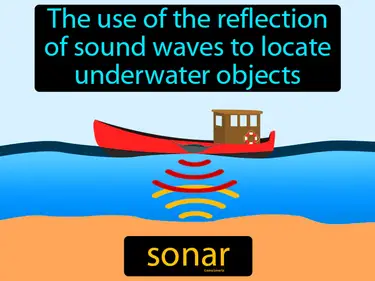
Sonar
This knowledge is used in careers such as:
Teacher (Teaches Students) ~$55,000 - $95,000 - Number of jobs: 4,700,000 (324,500 Openings Per Year) +2% Growth
Electrical Engineer (Designs Electrical Systems) ~$65,000 - $115,000 - Number of jobs: 295,000 (17,500 Openings Per Year) +7% Growth
Industrial Technician (Maintains & Repairs Machines) ~$50,000 - $75,000 - Number of jobs: 540,000 (54,000 Openings Per Year) +13% Growth
Doctor (Diagnoses and Treats Patients) ~$200,000 - $350,000 - Number of jobs: 840,000 (24,000 Openings Per Year) +3% Growth
Healthcare Tech (Administers Medical Tests & Procedures) ~$55,000 - $80,000 - Number of jobs: 270,000 (15,400 Openings Per Year) +5% Growth
Explore These Careers →

Example:
Imagine trying to find your keys in a dark room by clapping your hands and listening for the sound bouncing off objects. This is similar to how sonar works, where sound waves are emitted underwater and their echoes are used to detect objects. Just like your clapping creates sound waves that reflect off your keys and other items to reveal their location, sonar uses the reflection of sound waves to locate underwater objects by interpreting the returning echoes.
Practice Version

Sonar: The use of the reflection of sound waves to locate underwater objects is called sonar. Sonar is a technology that uses sound waves to detect and locate objects underwater.