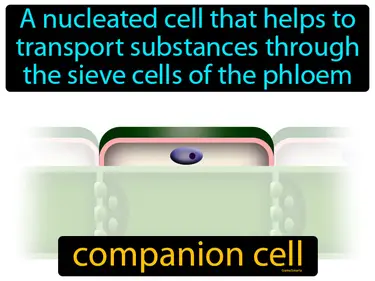
Companion Cell

Example:
Imagine you're trying to send a package to a friend across town, but you're unable to deliver it yourself. In this situation, you might rely on a courier service, which acts like the companion cell, ensuring your package (the substances) safely reaches your friend (the sieve cells). Just as the courier service facilitates the transport of your package by handling logistics and navigation, the companion cell supports the movement of substances through the phloem by managing the loading and unloading of nutrients into the sieve cells, ensuring they reach their destination efficiently.
Practice Version

Companion Cell: A nucleated cell that helps to transport substances through the sieve cells of the phloem. Companion cell. In simple terms, a companion cell is a type of plant cell that supports and aids the function of sieve tube elements in the phloem, facilitating the transport of nutrients.