Mole Fraction
Mole Fraction:
Imagine you're trying to decide what proportion of your monthly budget goes to different expenses like rent, groceries, and entertainment. This is similar to calculating the mole fraction, where you determine what part of the total solution is made up of a particular component. Just as you divide the amount of money spent on rent by your total monthly budget to find out its proportion, in chemistry, you divide the number of moles of a component by the total moles in the solution to find its mole fraction. Here, your rent is the component, your total budget is the total solution, and the proportion of rent is like the mole fraction, showing how much of the whole is taken up by that particular part.
Practice Version

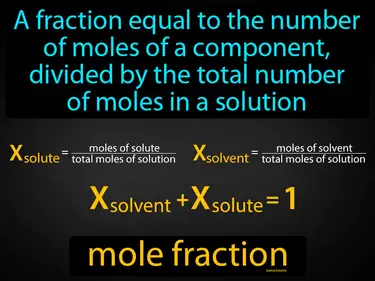
Mole Fraction: A fraction equal to the number of moles of a component, divided by the total number of moles in a solution. Mole fraction. It is a way to express the concentration of a specific component in a mixture or solution.