Anode
This knowledge is used in careers such as:
Teacher (Teaches Students) ~$55,000 - $95,000 - Number of jobs: 4,700,000 (324,500 Openings Per Year) +2% Growth
Electrician (Installs & Repairs Electrical Systems in Buildings) ~$50,000 - $90,000 - Number of jobs: 820,000 (81,000 Openings Per Year) +9% Growth
Industrial Technician (Maintains & Repairs Machines) ~$50,000 - $75,000 - Number of jobs: 540,000 (54,000 Openings Per Year) +13% Growth
Electrical Engineer (Designs Electrical Systems) ~$65,000 - $115,000 - Number of jobs: 295,000 (17,500 Openings Per Year) +7% Growth
Mechanical Engineer (Designs Machines) ~$65,000 - $115,000 - Number of jobs: 290,000 (18,100 Openings Per Year) +9% Growth
Explore These Careers →
Anode:
Imagine you're cooking and notice that the oil in your pan gradually turns darker as it heats and reacts with the food particles. Just like the oil changes due to its interaction with food, an anode is where oxidation occurs, meaning it loses electrons in a chemical reaction. In this analogy, the oil represents the anode, as both undergo a transformation through a process: the oil darkens with heat and food, while the anode loses electrons during oxidation.
Practice Version

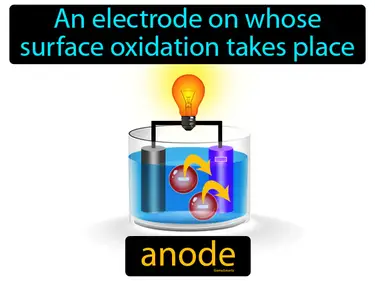
Anode: An electrode on whose surface oxidation takes place. anode. In simple terms, an anode is the part of a battery where electricity flows out, and chemical reactions take place.