Electrode
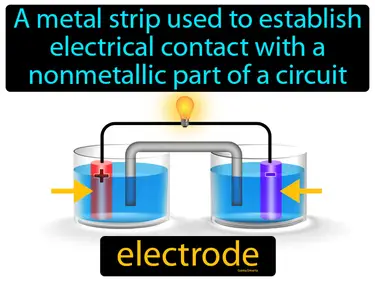
Electrode:
Imagine you're trying to attach a sticky note to a dusty wall, but it just won't stick because the surface isn't right. This is similar to how an electrode works in a circuit, where you need a conductive material to connect a metal part (like your sticky note) to a nonmetallic part (like the dusty wall) to facilitate electricity flow. Just as you might use tape to bridge the gap between the sticky note and the wall, an electrode serves as that crucial link, ensuring a proper connection between different materials for the flow of electrical current.
Practice Version

Electrode: A metal strip used to establish electrical contact with a nonmetallic part of a circuit. Electrode. An electrode is a conductor that allows electricity to flow into or out of a device or material.