Convection

Example:
Imagine you're at a party, and the room gets crowded, so you move to a less crowded area to feel more comfortable. This is similar to how heat energy moves in liquids or gases, where it travels from a warmer, crowded area to a cooler, less crowded area. Just like you seek out space to feel more at ease, heat energy seeks cooler areas to balance out temperature differences, creating a flow that we call convection.
Practice Version

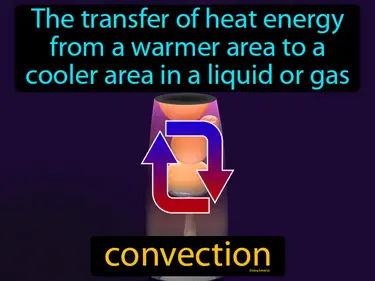
Convection: The transfer of heat energy from a warmer area to a cooler area in a liquid or gas. Convection is the process where heat moves through fluids like air or water as warm parts rise and cool parts sink.