Nuclear Energy

This knowledge is used in careers such as:

Civil Engineer (Designs Infrastructure) ~$65,000 - $110,000 - Number of jobs: 370,000 (23,600 Openings Per Year) +5% Growth

Electrical Engineer (Designs Electrical Systems) ~$65,000 - $115,000 - Number of jobs: 295,000 (17,500 Openings Per Year) +7% Growth

Mechanical Engineer (Designs Machines) ~$65,000 - $115,000 - Number of jobs: 290,000 (18,100 Openings Per Year) +9% Growth

Electrician (Installs & Repairs Electrical Systems in Buildings) ~$50,000 - $90,000 - Number of jobs: 820,000 (81,000 Openings Per Year) +9% Growth

Industrial Technician (Maintains & Repairs Machines) ~$50,000 - $75,000 - Number of jobs: 540,000 (54,000 Openings Per Year) +13% Growth

Explore These Careers →

Nuclear Energy Meaning

Example:

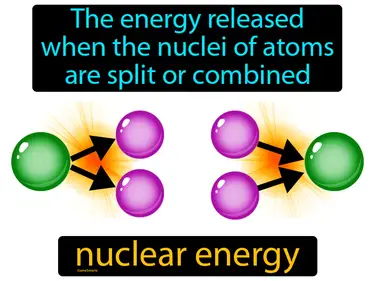
Imagine trying to open a tightly sealed jar of pickles; when you finally succeed, there's a sudden release of pressure. Similarly, nuclear energy involves the release of energy when the nuclei of atoms are split (like opening the jar) or combined. Just as the pressure build-up in the jar is released and can knock the lid off with force, the energy stored in atomic nuclei is unleashed when they're split apart or fused together, powering everything from electricity plants to the sun itself.
Nuclear Energy Definition

Practice Version

Nuclear Energy Definition

Nuclear Energy: The energy released when the nuclei of atoms are split or combined. Nuclear energy. It is the powerful energy generated in the core of an atom when tiny particles are split apart or fused together.

YouTube Video: