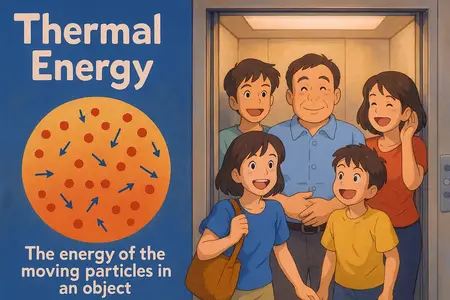
Thermal Energy
This knowledge is used in careers such as:
Civil Engineer (Designs Infrastructure) ~$65,000 - $110,000 - Number of jobs: 370,000 (23,600 Openings Per Year) +5% Growth
Electrical Engineer (Designs Electrical Systems) ~$65,000 - $115,000 - Number of jobs: 295,000 (17,500 Openings Per Year) +7% Growth
Mechanical Engineer (Designs Machines) ~$65,000 - $115,000 - Number of jobs: 290,000 (18,100 Openings Per Year) +9% Growth
Electrician (Installs & Repairs Electrical Systems in Buildings) ~$50,000 - $90,000 - Number of jobs: 820,000 (81,000 Openings Per Year) +9% Growth
Industrial Technician (Maintains & Repairs Machines) ~$50,000 - $75,000 - Number of jobs: 540,000 (54,000 Openings Per Year) +13% Growth
Explore These Careers →

Example:
Imagine you've been stuck in a crowded elevator with several people, each person shifting and fidgeting as the elevator moves. Just like those people moving around, thermal energy is the energy from the movement of particles within an object. The more the people (particles) are moving around due to agitation (heat), the more energy (thermal energy) the entire group (object) possesses, illustrating how increased movement leads to increased thermal energy.
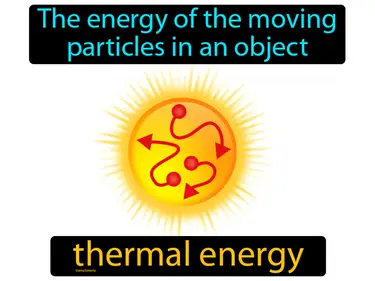
Practice Version
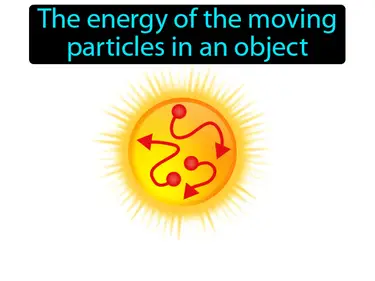
Thermal Energy: The energy of the moving particles in an object. Thermal energy. Thermal energy is the heat produced by the movement of tiny particles inside a substance.