Ultraviolet Radiation

Example:
Imagine you're at a crowded concert, and despite being surrounded by people, you can't see the stage clearly. Ultraviolet radiation behaves similarly in that it's part of the electromagnetic spectrum that we can't see, just like the stage is hidden from view. Just as the crowd's density blocks your view, ultraviolet rays are shorter than visible light, slipping past the "crowd" of longer wavelengths, affecting your skin by tanning it or even causing harm like skin cancer.
Practice Version

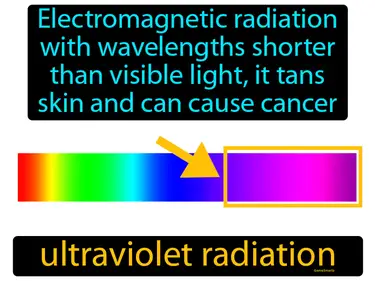
Ultraviolet Radiation: Electromagnetic radiation with wavelengths shorter than visible light, it tans skin and can cause cancer. Ultraviolet radiation. Ultraviolet radiation is a type of light from the sun that is invisible to the eye and can cause skin damage.