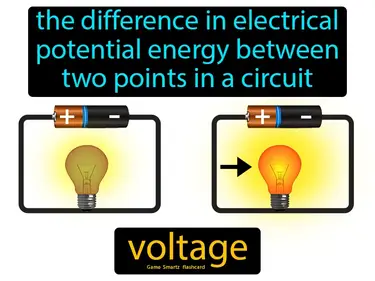
Voltage

Example:
Imagine you're riding a bicycle up a hill and then down the other side. This ride is similar to the concept of voltage in a circuit because just as you feel a difference in effort and speed depending on whether you're climbing or descending, voltage represents the difference in energy between two points in a circuit. The uphill effort is like the higher electrical potential energy, while the downhill speed represents the lower potential energy, showing how voltage drives the 'flow' of electrical current from high to low energy, much like gravity pulls you downhill.
Practice Version

Voltage: The difference in electrical potential energy between two points in a circuit. Voltage. Voltage is like the pressure that pushes electrical charges through a circuit.