Heat Capacity
Heat Capacity:
Imagine you're trying to fill up a pool using a garden hose, and you notice that the time it takes to fill the pool depends on its size. This situation is similar to how heat capacity works, where the amount of heat energy required to increase an object's temperature depends on the object's size and composition. Just as a larger pool needs more water to be filled, an object with a higher heat capacity requires more heat energy to raise its temperature by 1°C.
Practice Version

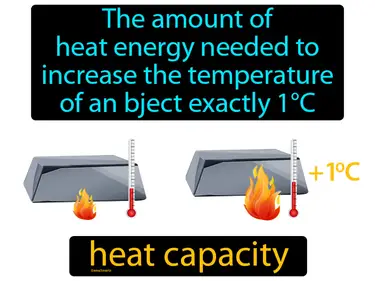
Heat Capacity: The amount of heat energy needed to increase the temperature of an object exactly 1C. Heat capacity. Heat capacity is the measure of how much heat energy an object can absorb before its temperature rises by 1C.