Dry Ice

This knowledge is used in careers such as:

Teacher (Teaches Students) ~$55,000 - $95,000 - Number of jobs: 4,700,000 (324,500 Openings Per Year) +2% Growth

Civil Engineer (Designs Infrastructure) ~$65,000 - $110,000 - Number of jobs: 370,000 (23,600 Openings Per Year) +5% Growth

Mechanical Engineer (Designs Machines) ~$65,000 - $115,000 - Number of jobs: 290,000 (18,100 Openings Per Year) +9% Growth

Industrial Technician (Maintains & Repairs Machines) ~$50,000 - $75,000 - Number of jobs: 540,000 (54,000 Openings Per Year) +13% Growth

Military (Operates Equipment Systems & Teams) ~$45,000 - $95,000 - Number of jobs: 2,100,000 (190,000 Openings Per Year) +2% Growth

Explore These Careers →

Dry Ice:

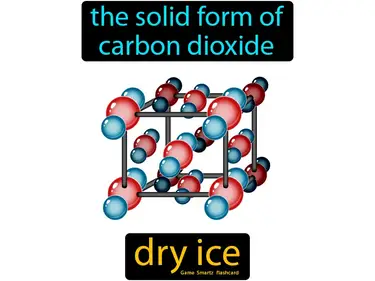
Imagine trying to keep your drink cold at a picnic without access to a refrigerator; you might use ice cubes that eventually melt and turn into water. Similarly, dry ice, which is the solid form of carbon dioxide, sublimates, or turns directly from a solid into a gas, without becoming a liquid first. Just as ice cubes cool your drink through melting, dry ice cools its surroundings by sublimating, but instead of leaving a puddle, it disappears into the air, like a magician's disappearing act.
Dry Ice Definition

Practice Version

Dry Ice Definition

Dry Ice: The solid form of carbon dioxide. Dry ice. Dry ice is the frozen form of carbon dioxide and is used to keep things cold without leaving any liquid residue.