Longitudinal Wave

Example:
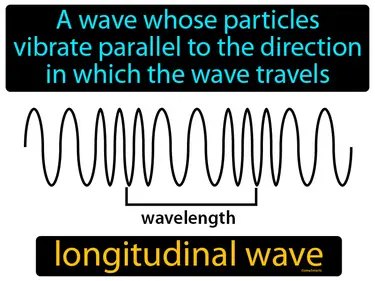
Imagine trying to squeeze through a crowded hallway where everyone is walking in the same direction as you are moving. This scenario is similar to a longitudinal wave, where particles in the medium move parallel to the direction the wave travels. Just like how people in the hallway move forward by jostling each other forward, particles in a longitudinal wave, such as sound waves, push and pull on each other in the same direction as the wave's movement, creating areas of compression and rarefaction as the wave propagates.
Practice Version

Longitudinal Wave: A wave whose particles vibrate parallel to the direction in which the wave travels. Longitudinal wave. It is a type of wave where the movement of the particles is in the same direction as the wave travels, like sound waves in air.