Gamma Ray

Example:
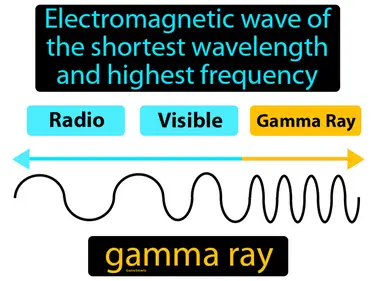
Imagine trying to tune into a radio station while driving, but you keep getting static instead of your favorite song. This is like how gamma rays are the most extreme form of electromagnetic waves, with their ultra-short wavelengths and high frequencies making them the hardest to 'catch' or detect in the electromagnetic spectrum. Just as a stronger, clearer signal is needed to override the static and bring your music into focus, gamma rays require advanced instruments to capture their intense and elusive energy, distinguishing them from other, less intense forms of electromagnetic waves like radio waves.
Practice Version

Gamma Ray: Electromagnetic wave of the shortest wavelength and highest frequency gamma ray. Gamma rays are incredibly powerful bursts of energy that come from the nuclei of atoms and are used in medical treatments and scientific research.