Microwave

Example:
Imagine trying to get a message across a crowded room at a party by waving your arms to catch someone's attention. Just as your arm movements create visible signals that travel through the air to communicate with someone across the room, microwaves use electromagnetic radio waves to transmit energy. In this analogy, your waving arms are like the radio waves, your specific arm movements are akin to the varying wavelengths in the microwave spectrum, and the message reaching your friend is similar to the microwave energy being absorbed by food to heat it.
Practice Version

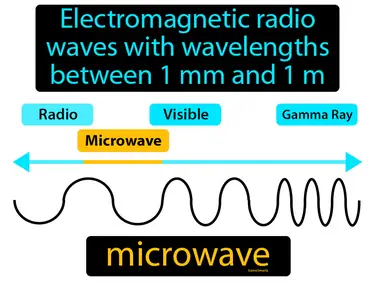
Microwave: Electromagnetic radio waves with wavelengths between 1 mm and 1 m. Microwave. Microwaves are a type of electromagnetic radiation used for cooking food and transmitting information like Wi-Fi signals.