X-Ray

Example:
Imagine you're in a crowded room trying to hear a conversation with a friend, but everyone is talking loudly. Just as you might need to tune into a higher pitch to hear your friend's voice over the noise, x-rays operate at a higher frequency, allowing them to 'cut through' materials that would otherwise block lower frequency waves like visible light. In this analogy, the crowded room represents the multitude of frequencies in the electromagnetic spectrum, your friend's voice is like the penetrating power of x-rays, and the ability to focus on that higher pitch amidst the noise mirrors how x-rays bypass obstacles that stop other waves, such as UV.
Practice Version

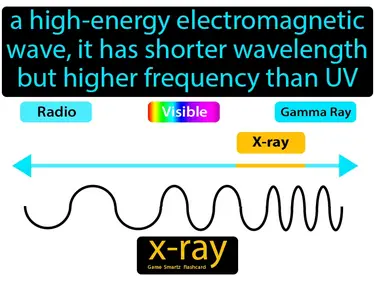
X-Ray: A high-energy electromagnetic wave, it has shorter wavelength but higher frequency than UV. X-ray. X-rays are a type of radiation that can pass through most objects, including the body, and are commonly used to create images of bones and internal organs.