Ultraviolet Wave

Example:
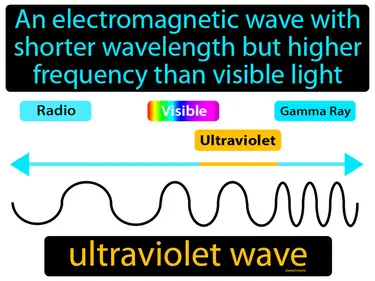
Imagine you're trying to fit more items into a suitcase that's already packed full. Just like you need to pack smaller, more compact items to fit more into the same space, ultraviolet waves are similar because they have shorter wavelengths, allowing more of them to "fit" into a given space compared to visible light. In this analogy, the smaller items represent the shorter wavelengths of ultraviolet light, while the higher frequency of items being packed represents the higher frequency of ultraviolet waves compared to the bulkier items of visible light.
Practice Version

Ultraviolet Wave: An electromagnetic wave with shorter wavelength but higher frequency than visible light. Ultraviolet wave. Ultraviolet waves are invisible rays from the sun that can cause sunburn and are used in sterilization.