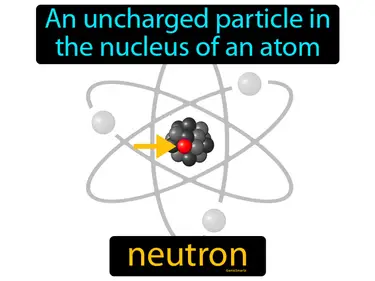
Neutron

Example:
Imagine you're at a family gathering where everyone is having different conversations, and you're the person who neither argues nor takes sides, simply keeping the peace. Just like you in this scenario, a neutron stays neutral in the nucleus of an atom, not taking on any charge like protons (positive) or electrons (negative). In this analogy, the family gathering represents the nucleus, the different conversations are the interactions between charged particles, and you, remaining neutral, embody the role of the neutron, maintaining balance without contributing to the charge.
Practice Version

Neutron: An uncharged particle in the nucleus of an atom. Neutron. A neutron is a subatomic particle with no electric charge that resides in an atom's nucleus, helping to hold the nucleus together.