Cathode Ray
This knowledge is used in careers such as:
Electrical Engineer (Designs Electrical Systems) ~$65,000 - $115,000 - Number of jobs: 295,000 (17,500 Openings Per Year) +7% Growth
Mechanical Engineer (Designs Machines) ~$65,000 - $115,000 - Number of jobs: 290,000 (18,100 Openings Per Year) +9% Growth
Doctor (Diagnoses and Treats Patients) ~$200,000 - $350,000 - Number of jobs: 840,000 (24,000 Openings Per Year) +3% Growth
Healthcare Tech (Administers Medical Tests & Procedures) ~$55,000 - $80,000 - Number of jobs: 270,000 (15,400 Openings Per Year) +5% Growth
Registered Nurse (Manages Patient Care) ~$65,000 - $100,000 - Number of jobs: 3,400,000 (189,000 Openings Per Year) +5% Growth
Explore These Careers →
Cathode Ray:
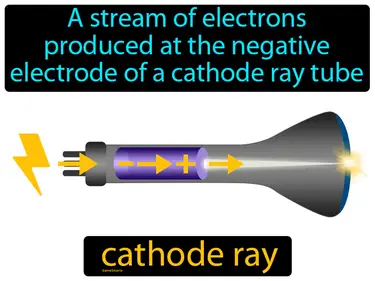
Imagine trying to get a crowd of people to move quickly through a narrow hallway to reach an exit. This is similar to the way a cathode ray works, where electrons are funneled from the negative electrode, like the crowd, through a narrow tube. In this analogy, the people represent electrons, the narrow hallway is the cathode ray tube, and the exit they are heading towards is the positive electrode, effectively demonstrating how directed movement occurs in both scenarios.
Practice Version

Cathode Ray: A stream of electrons produced at the negative electrode of a cathode ray tube. Cathode ray. A cathode ray is a beam of electrons traveling through a vacuum in a cathode ray tube.