Buoyancy

Example:
Imagine trying to hold a beach ball underwater in a swimming pool—it always seems to pop back up to the surface no matter how hard you try. This is similar to how buoyancy works, where fluids exert an upward force on objects immersed in them, keeping them afloat. Just like the air inside the beach ball makes it want to rise to the surface against your efforts, buoyancy lifts objects in a fluid, with the water pushing back against the weight of the ball, analogous to how buoyant force counteracts the weight of an object in water.
Practice Version

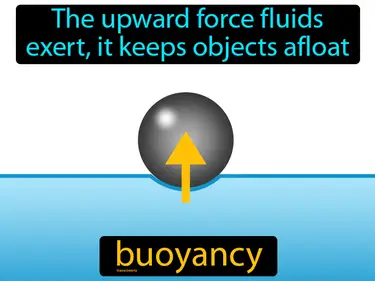
Buoyancy: The upward force fluids exert, it keeps objects afloat. Buoyancy. Buoyancy is the tendency of an object to float in a fluid due to the upward force the fluid applies.