Neutral Buoyancy
Neutral Buoyancy:
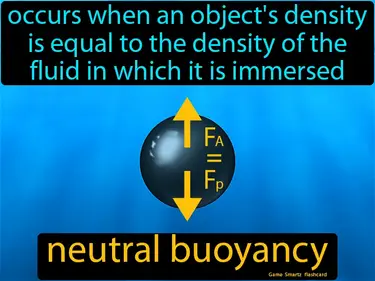
Imagine trying to balance a seesaw perfectly so that neither side touches the ground. This is similar to neutral buoyancy, where an object remains suspended in a fluid without sinking or floating because its density matches that of the fluid. Just as the seesaw remains level when both sides have equal weight, an object achieves neutral buoyancy when its density is equal to the fluid's density, creating a perfect balance that prevents it from rising or sinking.
Practice Version

Neutral Buoyancy: Occurs when an object's density is equal to the density of the fluid in which it is immersed. Neutral buoyancy. This means the object will neither sink nor float in the fluid.