Sino-Japanese War
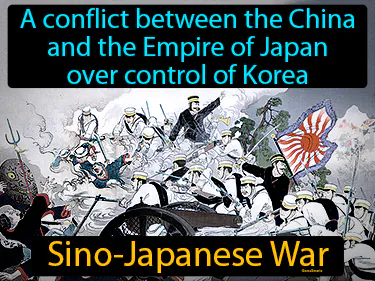
Sino-Japanese War:
The Sino-Japanese War, which took place from 1894 to 1895, was significant because it marked Japan's emergence as a major world power and a key player in the era of New Imperialism. It highlighted the intense competition among nations for territorial expansion and influence, with Japan seeking to control Korea to expand its empire. This war demonstrated the shift in power dynamics in Asia, where Japan, a previously isolated nation, began to dominate over China, which had been a historical power. Today, the ideas of territorial disputes and national pride that fueled the war are still relevant, as countries continue to navigate complex relationships and territorial claims. For an average person, these tensions can impact global trade, technology, and international relations, affecting everything from the prices of goods to how nations collaborate on global challenges like climate change.
Practice Version

Sino-Japanese War: A conflict between China and the Empire of Japan over control of Korea. Sino-Japanese War. The Sino-Japanese War was a late 19th-century conflict where Japan defeated China to gain influence over Korea.