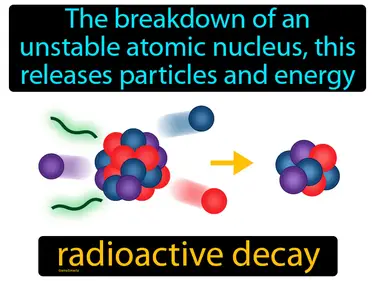
Radioactive Decay
This knowledge is used in careers such as:
Electrical Engineer (Designs Electrical Systems) ~$65,000 - $115,000 - Number of jobs: 295,000 (17,500 Openings Per Year) +7% Growth
Mechanical Engineer (Designs Machines) ~$65,000 - $115,000 - Number of jobs: 290,000 (18,100 Openings Per Year) +9% Growth
Doctor (Diagnoses and Treats Patients) ~$200,000 - $350,000 - Number of jobs: 840,000 (24,000 Openings Per Year) +3% Growth
Healthcare Tech (Administers Medical Tests & Procedures) ~$55,000 - $80,000 - Number of jobs: 270,000 (15,400 Openings Per Year) +5% Growth
Registered Nurse (Manages Patient Care) ~$65,000 - $100,000 - Number of jobs: 3,400,000 (189,000 Openings Per Year) +5% Growth
Explore These Careers →

Example:
Imagine you have a drawer stuffed to the brim with clothes, and every time you open it, a few items fall out. This is similar to radioactive decay, where an unstable atomic nucleus is like that overstuffed drawer, constantly shedding particles and energy to reach a more stable state. Just as the drawer releases clothes until it can close more comfortably, the nucleus emits particles and energy until it becomes more stable.
Practice Version

Radioactive Decay: The breakdown of an unstable atomic nucleus, this releases particles and energy. Radioactive decay. Radioactive decay is when an unstable atom loses energy and particles over time, turning into a different element.