Colligative Property
Colligative Property:
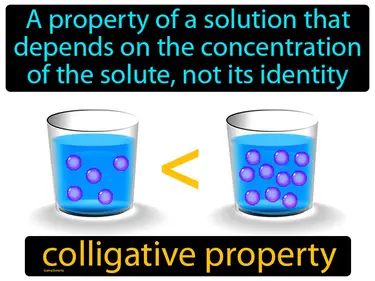
Imagine trying to squeeze onto a crowded bus during rush hour, where the amount of space available depends on how many people are already inside, not on who they are. Similarly, colligative properties of a solution—such as boiling point elevation or freezing point depression—depend on the concentration of the solute particles in the solution, not on the type of particles present. Just as the bus's capacity is affected by the sheer number of passengers rather than their identities, a solution's colligative properties are determined by the number of solute particles, regardless of their specific characteristics.
Practice Version

Colligative Property: A property of a solution that depends on the concentration of the solute, not its identity. Colligative property. Colligative properties are changes in a solution that happen because of how much stuff is dissolved in it, like lowering the freezing point or raising the boiling point.