Primary Wave

Example:
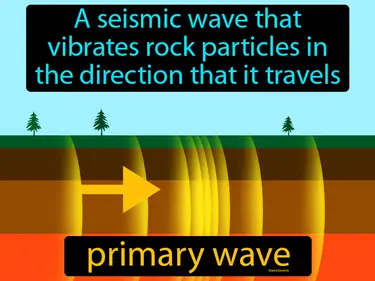
Imagine you're at a packed concert, and everyone starts to move forward as the main act begins. This is similar to a primary seismic wave because, just like the crowd pushing forward, it causes the particles of rock to move in the same direction that the wave itself is traveling. In this analogy, the concertgoers are like the rock particles, and the forward surge of the crowd represents the primary wave that pushes everything in its path forward, illustrating how energy propagates through the Earth during an earthquake.
Practice Version

Primary Wave: A seismic wave that vibrates rock particles in the direction that it travels. Primary wave. A primary wave, or P-wave, is a type of seismic wave that compresses and expands material in the same direction it moves, quickly traveling through Earth's crust during an earthquake.