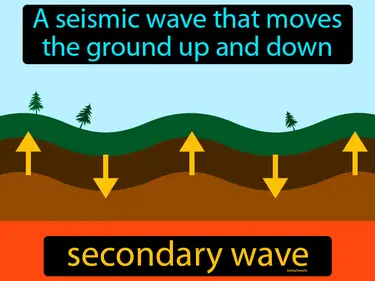
Secondary Wave

Example:
Imagine standing in a line at a concert where the crowd is so eager that they start to push and pull, causing you to sway up and down with their movements. This is similar to how secondary waves, or S-waves, in an earthquake move the ground up and down as they travel through it. Just like how the crowd's energy causes you to move without you having direct control, S-waves transfer energy through the Earth, causing the ground to oscillate vertically, much like your body does in that concert line.
Practice Version

Secondary Wave: A seismic wave that moves the ground up and down. Secondary wave. A secondary wave, or S-wave, is a type of seismic wave that shakes the ground perpendicular to its direction of travel, causing up-and-down or side-to-side motion.