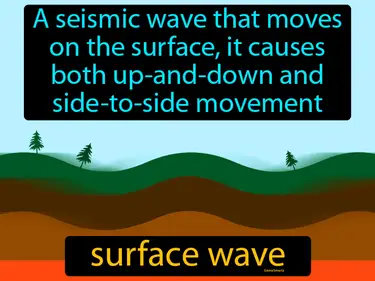
Surface Wave

Example:
Imagine trying to walk on a trampoline while someone is jumping on it from the other side. This situation is similar to a seismic surface wave, where the ground you stand on moves both up-and-down and side-to-side, much like the trampoline surface swaying due to the jumper's movements. Just as the trampoline's surface undulates in multiple directions, causing you to lose balance, seismic surface waves travel along the Earth's surface, creating complex movements that result in both vertical and horizontal displacements.
Practice Version

Surface Wave: A seismic wave that moves on a surface, it causes both up-and-down and side-to-side movement. Surface wave. In simple terms, a surface wave is a type of seismic wave that travels along the Earth's surface, causing shaking and movement.