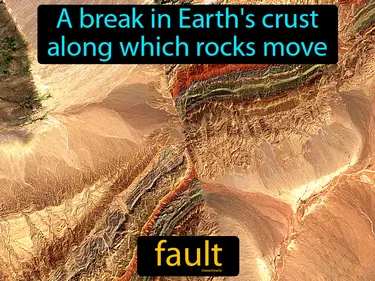
Fault
This knowledge is used in careers such as:
Teacher (Teaches Students) ~$55,000 - $95,000 - Number of jobs: 4,700,000 (324,500 Openings Per Year) +2% Growth
Civil Engineer (Designs Infrastructure) ~$65,000 - $110,000 - Number of jobs: 370,000 (23,600 Openings Per Year) +5% Growth
Mechanical Engineer (Designs Machines) ~$65,000 - $115,000 - Number of jobs: 290,000 (18,100 Openings Per Year) +9% Growth
Architect (Designs Buildings) ~$60,000 - $105,000 - Number of jobs: 120,000 (7,800 Openings Per Year) +4% Growth
Industrial Technician (Maintains & Repairs Machines) ~$50,000 - $75,000 - Number of jobs: 540,000 (54,000 Openings Per Year) +13% Growth
Explore These Careers →

Example:
Imagine walking on a sidewalk when you suddenly come across a crack where the two sides have shifted slightly apart. Just like this crack disrupts the smooth path you intended to walk on, a fault is a break in Earth's crust where sections of rock have moved relative to each other. In both cases, the crack represents a division where shifts have occurred—on the sidewalk, it's the concrete slabs moving apart, while in Earth's crust, it's the movement of rocks along the fault line.
Practice Version

Fault: A break in Earth's crust along which rocks move. Fault. It is where Earth's plates slide past each other, causing earthquakes.