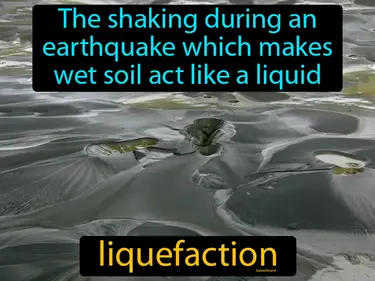
Liquefaction

Example:
Imagine trying to walk across a beach with a bucket of water, only to have the sand shift beneath your feet, causing you to spill the water. This is similar to how the shaking during an earthquake can make wet soil lose its solid ground characteristics and behave like a liquid. Just as the sand's instability makes it hard to balance, the vibrations from an earthquake loosen the particles in wet soil, reducing friction and allowing them to flow more freely, effectively turning the ground into a liquid-like state.
Practice Version

Liquefaction: The shaking during an earthquake which makes wet soil act like a liquid is called liquefaction. Liquefaction happens when the ground shakes and waterlogged soil loses its strength, causing it to flow like a liquid.