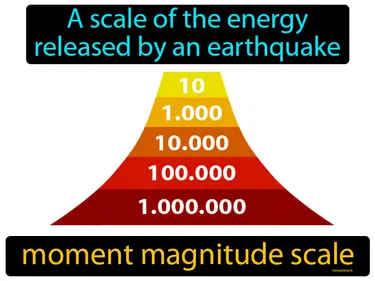
Moment Magnitude Scale

Example:
Imagine you're at a party and someone accidentally drops a glass, causing it to shatter loudly on the floor. Just like the noise and mess from the broken glass give you an idea of the impact of the drop, the moment magnitude scale measures the energy released by an earthquake. In this analogy, the glass is the Earth's crust, the drop is the tectonic shift, and the noise and mess are the earthquake's energy; the moment magnitude scale quantifies the "mess" to tell us how powerful the earthquake is.
Practice Version

Moment Magnitude Scale: A scale of the energy released by an earthquake. Moment magnitude scale. The moment magnitude scale measures the size of earthquakes by calculating the energy they release.