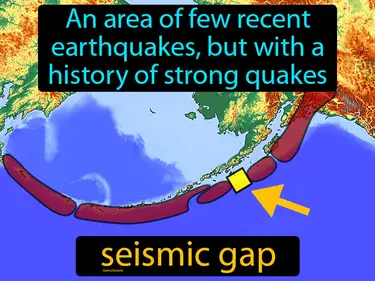
Seismic Gap

Example:
Imagine a crowded highway where traffic suddenly clears up, giving you a smooth ride, but you know from experience that a traffic jam is likely just around the corner due to the usual congestion patterns. This situation is similar to a seismic gap, where an area has been relatively quiet with few earthquakes recently, despite a history of strong seismic activity indicating potential for future quakes. Just as the cleared highway suggests an upcoming jam based on past traffic behavior, a seismic gap signifies a buildup of stress along a fault line, making it likely to release as a future earthquake.
Practice Version

Seismic Gap: An area of few recent earthquakes, but with a history of strong quakes. Seismic gap. A seismic gap is a section of a fault that has not experienced significant earthquakes for a long time, suggesting it may be due for a future quake.