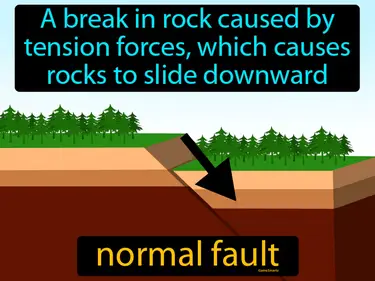
Normal Fault

Example:
Imagine trying to pull apart a sandwich that's been tightly packed, only to see the top slice of bread slide off and fall to the side. This situation is similar to a normal fault, where tension forces in the Earth's crust cause a section of rock to slide downward. Just like how the tension you apply to separate the sandwich causes the top slice to shift and drop, tension in the Earth's crust pulls rocks apart, leading to one block sliding down relative to the other, illustrating the movement along a normal fault.
Practice Version

Normal Fault: A break in rock caused by tension forces, which causes rocks to slide downward. Normal fault. A normal fault occurs when tension forces in the Earth's crust pull rocks apart, causing one block to slip downward.