Reverse Fault

Example:
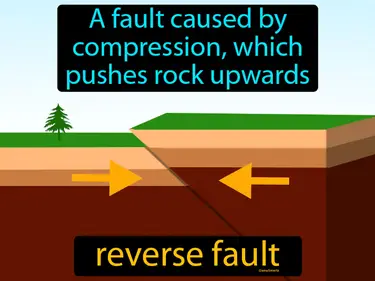
Imagine trying to fit too many clothes into a suitcase, resulting in some garments pushing upwards and spilling out as you attempt to close it. This is similar to a reverse fault in geology, where compression forces push rock layers upwards. Just as the clothes in the suitcase are squeezed and pushed upward due to limited space, rock layers in a reverse fault are compressed by tectonic forces, causing them to move and create an upward bulge.
Practice Version

Reverse Fault: A fault caused by compression, which pushes rock upwards. Reverse fault. A reverse fault occurs when two blocks of the Earth's crust are compressed together, causing one block to move up over the other.